
Neural sensitization or neuroplastic pain (sometimes called central sensitization), is a condition where the nervous system becomes overly reactive and continues to produce pain even after the original tissue injury or illness may have healed. Neural sensitization is still thought to be the primary cause of chronic pain in cases where there are persistent anatomical changes such as scar tissue, metal implants or anatomical distortion.
Neural sensitization is a natural part of our body’s protective mechanisms. When you are injured, your body creates pain, including in areas around the injury that were not injured themselves. The body does this to remind us to protect ourselves. This mechanism is supposed to be shut off when you have healed, but sometimes it doesn’t and that leads to chronic pain.
In other words, the pain system stays “on” – the brain and spinal cord gets regulated in a persistent state of high reactivity amplifying pain signals. This isn’t psychological or imaginary; it’s a real, physical change in how your nervous system functions. This process is driven by neuroplasticity, the brain and spinal cord’s ability to change in response to repeated signals. Just like the brain can learn new languages or skills, it can also “learn” pain when signals are repeated too often or for too long.
Chronic pain patients can sometimes think they are going crazy because they know intellectually that touch or simple bumps shouldn’t cause the amount of pain that they experience. They also see how health professionals, friends and loved ones react when they witness the chronic pain patient grimacing at the slightest touch or crying out at the simplest bump. Even if the other people don’t say it, the chronic pain patient can easily start to think they are being judged. The difference is that the other people don’t have a nervous system that is stuck in a persistent state of neural sensitization. If you want to help them understand ask if they know what it is like when they have a sunburn.
Defining Characteristics
There is no diagnostic test, scan or study that can show neural sensitization. It is a clinical diagnosis made based on history and physical examination by someone who has expertise in managing chronic pain. Neuroplastic pain has some defining characteristics, but not all have to be present:
- Pain that starts in one area and gradually expands to include more areas or even the whole body.
- Shifting pain: Pain that seems to shift from place to place or side to side at different times (note that it can also remain in one location primarily)
- Response to stress: Increased pain intensity during periods of physical, emotional or mental stress.
- Poor response to analgesic medications
- Prolonged recovery: It takes much longer than expected to recover from pain exacerbations
- Poor sleep: people often complain that they never feel rested
- Sensitivity to side effective of medications
- Cognitive symptoms such as “brain fog”, short term memory issues, poor concentration
- Anxiety, depression, PTSD symptoms, emotional lability
- Sensitivity to lights, sounds, smells or touch
- “Difficult to freeze” during dental or medical procedures
- Allodynia: Feeling pain from things that don’t normally hurt, like a light touch or light pressure, or even just the touch of clothing or wind on the skin.
- Hyperalgesia: Feeling much more pain than expected from something that normally hurts just a little. For example, when a simple bump which ordinarily might be mildly painful sends the chronic pain patient through the roof with pain.
Associated syndromes
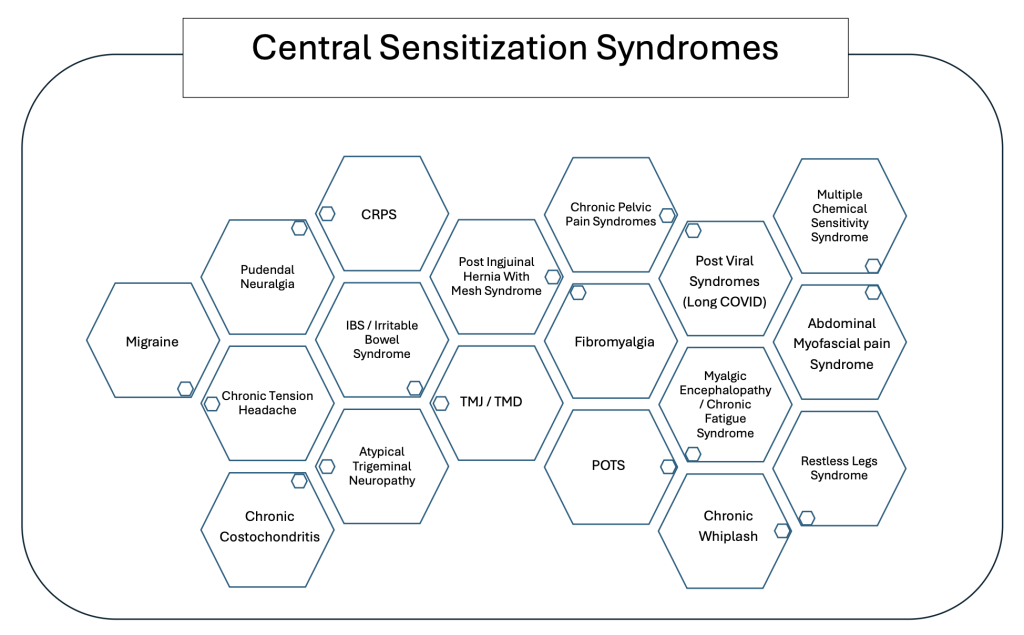
Neuroplastic pain can be focal to a small area or can be diffuse. Sometimes it starts in one area and is always there but also occurs in other areas to a lesser degree. Sometimes it only affects one side of your body and not the other. Sometimes we give it a specific name, like in the diagram below (the chart is an example only, there are many more). If it crosses domains or affects multiple areas, we may call it functional neurological disorder or just central sensitization syndrome.
What causes neuroplastic pain?
There’s no single cause or reason why a person’s acute back strain turns into chronic pain or intermittent migraines turn into chronic daily headaches. It is important to understand that some people develop neuroplastic pain even when they do everything right. Neural sensitization is actually a natural part of our body’s protective mechanisms. When you are injured, your body creates pain, even in areas around the injury that were not injured themselves to remind us to protect ourselves. This mechanism is supposed to be shut off when you have healed, but sometimes it doesn’t. Over time specific parts of the nervous system change (that’s the definition of plastic or moldable). Receptor and cellular level changes occur in the dorsal horn of the spinal cord and in the brain. The longer these changes have been present the harder they are to reverse.
There are many factors that likely contribute to the development of central sensitization, some of which are “predisposing factors” and some are “post-injury factors”
Predisposing factors are those that are associated with the state of the central nervous system prior to onset of the original injury or pain condition. There are likely both biological, psychological, and environmental predisposing factors.
If you have a parent or sibling with chronic pain, then you are more likely to have chronic pain. Twin studies have shown between 30-50% correlation suggesting a moderate genetic influence. However, the specific genes have not been well characterized. There is little information as yet to support a causal link between pre-existing pain thresholds and subsequent development of central sensitization following an injury although it is likely that one will eventually be found.
There is a clear relationship between stress-response and lowering of pain thresholds. Anxiety, and specifically pain anxiety is strongly associated with higher pain sensitivity (or lower pain threshold). People who develop strong coping strategies show lower pain sensitivity. Anxiety makes the nervous system more reactive. It makes sense that a more reactive or dysregulated nervous system prior to or around the time of injury might make the nervous system more prone to becoming centrally sensitized after the injury.
It is important to note that these predisposing factors are not the cause and that people can develop chronic pain even if they don’t have any predisposing factors. These predisposing factors likely represent an already dysregulated nervous system at the time of injury, and this may interfere with the normal trajectory of healing and thereby prevent pain from subsiding once tissue damage heals.
Post-injury factors are those that make people prone to the development of chronic pain once an injury or illness occurs. The already dysregulated nervous system at the time of injury for instance, may interfere with the normal trajectory of healing and thereby prevent pain from subsiding once tissue damage heals.
The onset of pain is often associated with subsequent development of conditions such as depression, fear-avoidant anxiety and other stressors. The stress of these responses can in turn, further exacerbate the reactivity of the nervous system, leading to central sensitization.
Poor sleep is also a common consequence of living with chronic pain. It is associated with increased sensitivity to pain as well.
External locus of control means that a person feels they have no influence on what happens to them or their bodies. If a person believes nothing they do will help, they are more likely to interpret pain as threatening, avoid moving and increase reliance on passive treatments (pills, manipulations, procedures, etc.) While this does avoid pain aggravations in the short term, it leads to worse pain over the long term and an even harder path to recovery. Studies in animals and people have also shown that believing one has no control increases stress, dysregulates the hypothalamic–pituitary–adrenal (HPA) axis, and contributes to increased sensitization, impaired sleep, fatigue and immune dysregulation.
Treatments for neuroplastic pain
Treatments for chronic pain syndromes that involve neuroplastic pain require multimodal therapy. Injections and passive therapies such as IMS, chiropractic adjustments, acupuncture, massage, etc., do not target the underlying problem. Focusing exclusively on passive therapies can actually make you worse over time.
Evidence-based treatment for neuroplastic pain integrates current best practices from pain neuroscience, cognitive-behavioural frameworks, and interdisciplinary rehabilitation. This is an active area of research, and the protocols and theories are always evolving.
Education:
- We want to shift your concept of pain from “tissue damage” to “brain-driven pain.”
- The more you understand what is actually causing your pain the better you will do
- This is best does with a structured program
- If you are an active patient at the Helmcken Pain Clinic you can access our mindfulness-based CBT skills for chronic pain group (offered several times a year) or our integrated physiotherapy program.
Cognitive Behavioural Therapy (CBT) or Acceptance and Commitment Therapy (ACT):
- Some online options include:
- A private psychologist may also offer individualized therapy if you have access
Pain Reprocessing Therapy
- On iPhone or Android phones: the Curable App – this is highly recommended
- Some physiotherapists offer this therapy
Movement and Graded Exercise Therapy
- Restoring or, at a minimum, maintaining movement and range of motion is essential for long-term pain management. The maxim: use it or lose it applies here. However, you must start at a very low level and increase the duration and intensity very slowly. If you do too much all at once, your pain will flare and you will develop more fear of movement. Start with less than you think you can do and gradually work up. Be persistent but also listen to your body. You will see benefits, but it will take dedicated work over a long time. Expect 6-12 months before you can look back and realize that you are improving. Your pain will get worse if you can’t do this.
Medications
- There are medications that can help with neuroplastic pain. They all work on nerves because that is where the problem lies, and therefore they all have potential nerve side effects such as sedation, cognitive impairment, tingling in the hands and feet, weight gain, nausea, etc.
- Traditional options have included pregabalin, gabapentin, nortriptyline, amitriptyline etc. Doctors sometimes prescribe low doses of these or other medications that specifically target the neural sensitization
- Avoid opioids (codeine, morphine, Dilaudid, Fentanyl, etc). While these medications can be effective for acute pain, they actually make chronic pain, and especially neuroplastic pain, worse through a mechanism known as opioid induced hyperalgesia.
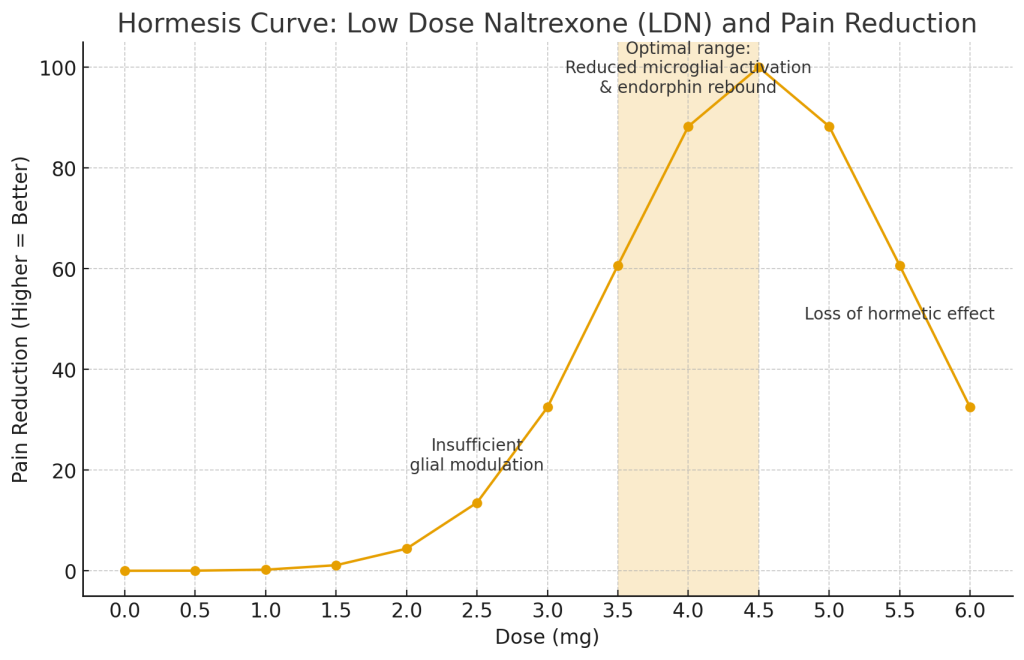
- Low-dose naltrexone (an opioid blocker) or low-dose aripiprazole (a mood stabilizer) can sometimes help reduce the neural sensitization. These are not pain killers per se, rather they work on the glial cells in your brain and settle down some of the nerve hyper reactivity. It is important to find the right dose. The medication loses its effect at too high a dose. However, the optimal dose is quite variable, with some people experiencing maximal benefit with as little as 1 mg and some requiring as much as 6 mg (see chart below)
Supplements
Some people find that certain supplements provide benefits. These have not been well studied, but there appear to be relatively few risks. Some options include:
- Palmitoylethanolamide (liposomal) – Poorly absorbed unless liposomal – Dose ~500 mg
- Alpha lipoic acid (best taken on an empty stomach) – Dose ~600 mg
- Reservatrol (best if it has black pepper or piperine in the formulation or taken at the same time) – high first pass metabolism, need a high dose
- PEA – Palmitoylethanolamide
- Vitamin D3, B-vitamins, CoQ10
- Magnesium bisglycinate (especially for leg cramps, spasms and migraines)
- Vitamin B2 (especially for migraines)
Sleep and Recovery Optimization
- Sleep is vital for recovery. If you have insomnia, untreated obstructive sleep apnea, or disturbed sleep, then your body doesn’t have time to allow your nervous system to downregulate and heal.
- You may want to investigate cognitive strategies for insomnia, sleep hygiene, and relaxation techniques. These go beyond our expertise at the Helmcken Pain Clinic. There are many resources available online and via apps (Headspace is a good one)
Lifestyle and Stress Modulation
- Stress is a significant pain aggravator in neuroplastic pain, so it makes sense to do whatever you can to reduce it.
- Mindfulness-based stress reduction (MBSR).
- Diaphragmatic breathing.
- Journaling, expressive writing.
- Social connections tend to be severed when people have injuries or chronic pain. The more isolated people get, the worse they tend to do. We encourage you to maintain meaningful social activity as much as you can. You may not be able to do what you were capable of in the past, so look for ways to explore new interests and hobbies that allow you to connect with others.
- Many people find the Curable app very useful. It is available on the iPhone and Android App Stores.